
Imagine calling a customer support hotline and being greeted by an AI voice that sounds almost human. The pronunciation is clear, the pacing feels natural, and the responses are easy to understand. Achieving that level of quality doesn’t happen by accident.
Behind every successful AI voice is a process of testing, evaluation, and continuous improvement. Companies need real people to listen to AI-generated recordings, identify potential issues, and provide feedback before these voices are deployed to millions of users.
Through Microworkers, employers can quickly access a diverse global workforce capable of evaluating AI-generated audio and helping developers build more accurate, natural, and engaging voice technologies.
Why AI-Generated Audio Needs Human Evaluation
Artificial Intelligence has made tremendous progress in generating realistic speech. Today, AI voices are used in virtual assistants, navigation systems, audiobooks, customer support platforms, educational tools, accessibility solutions, and content creation applications.
However, even the most advanced voice models can still produce imperfections that automated testing may fail to detect.
For example, an AI-generated voice may:
- Mispronounce certain words.
- Place emphasis on the wrong syllables.
- Sound too robotic or unnatural.
- Pause at awkward moments.
- Express an incorrect emotional tone.
- Produce inconsistent pronunciation throughout a recording.
While AI systems can analyze technical metrics, human listeners remain the best judges of how natural and understandable a voice truly sounds.
How Microworkers Supports AI Audio Evaluation Projects
Microworkers allows employers to launch campaigns where workers listen to AI-generated audio and provide structured feedback.
Depending on the project’s goals, workers may be asked to:
– Rate Speech Clarity
Can the recording be easily understood?
Workers can evaluate whether the speech is clear, muffled, distorted, or difficult to follow.
– Assess Naturalness
One of the most important aspects of AI-generated speech is how human it sounds.
Workers can determine whether the voice sounds natural, conversational, and pleasant to listen to, or whether it still exhibits robotic characteristics.
– Identify Pronunciation Issues
Human reviewers can detect words that are mispronounced or spoken incorrectly, helping developers improve language models and pronunciation dictionaries.
– Evaluate Emotional Expression
Many modern AI voices are designed to convey emotions such as happiness, excitement, empathy, or concern.
Workers can verify whether the intended emotional tone matches the actual delivery of the audio.
– Detect Audio Artifacts
Listeners can identify issues such as:
- Audio glitches
- Unnatural pauses
- Repeated words
- Missing words
- Abrupt transitions
- Background noise artifacts
These issues may significantly impact the user experience and often require human feedback to uncover.
Ready-to-Use Template for AI Audio Evaluation Campaigns
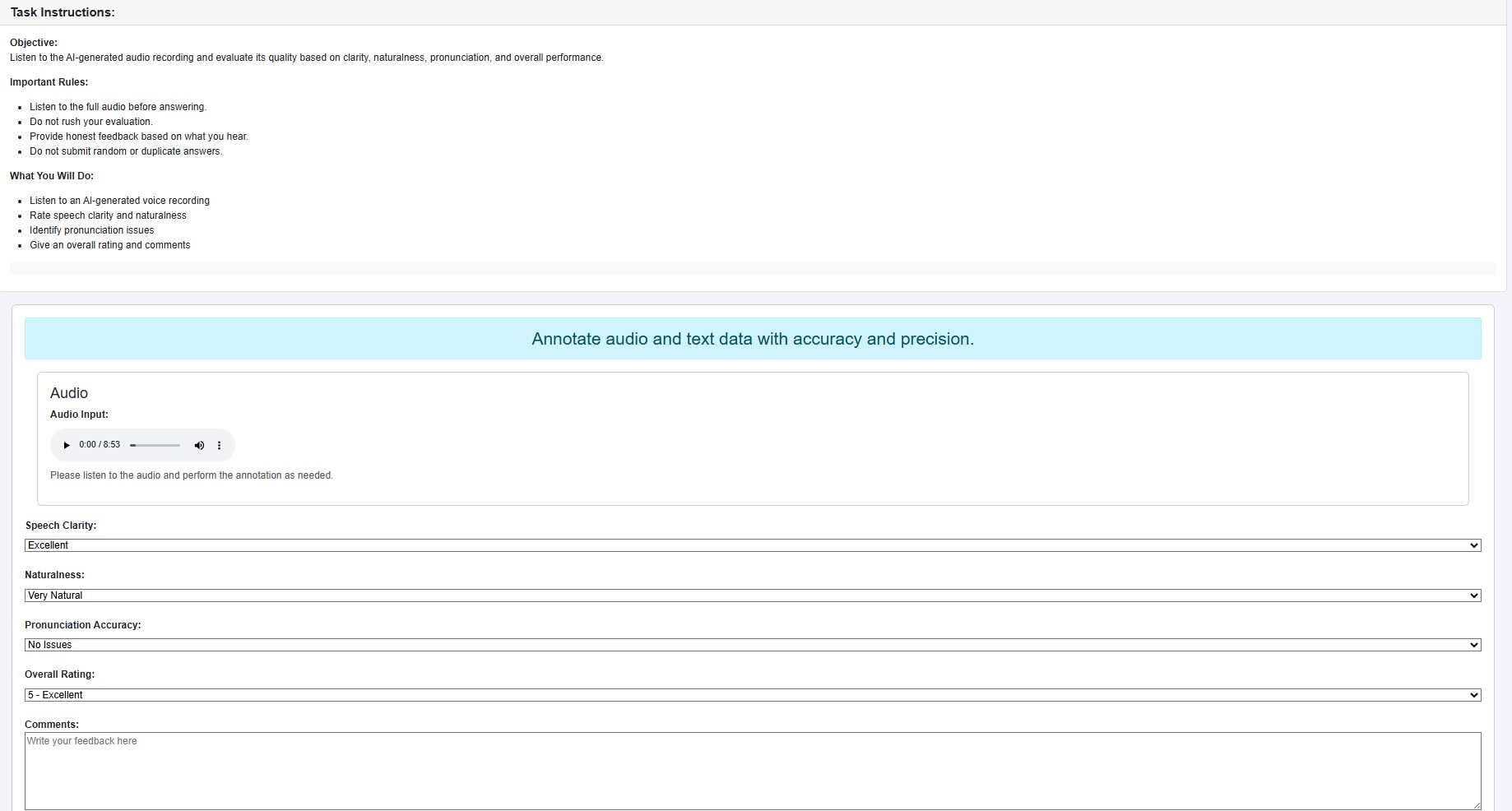
To help employers quickly launch their own Audio AI evaluation campaigns, Microworkers provides a ready-to-use template structure that can be directly adapted for audio quality testing tasks.
This template is designed for AI-generated audio evaluation projects where workers listen to recordings and provide structured feedback based on clarity, naturalness, pronunciation, and overall voice quality.
Below is a default template that employers can immediately use or customize depending on their campaign requirements.
Customization Options
Employers can easily modify this template depending on their needs:
- Add emotion evaluation (happy, sad, neutral, excited)
- Include A/B audio comparisons
- Add quality checks (attention questions)
- Expand rating scales for more detailed analysis
- Localize instructions for multilingual campaigns
The Value of a Global Workforce
Voice technology is used by people from different countries, cultures, and linguistic backgrounds. An AI voice that sounds natural to one group of users may sound unusual to another.
Microworkers provides access to workers from around the world, allowing employers to gather feedback from diverse audiences. This helps developers better understand how their audio performs across different accents, dialects, and language communities.
For organizations building global products, diverse feedback can be just as important as the technology itself.
Benefits for Employers
Running AI audio evaluation campaigns on Microworkers offers several advantages:
-
Scalability
Projects can collect feedback from a small group of workers or from thousands of participants, depending on business needs.
-
Speed
Employers can receive large volumes of evaluations quickly, accelerating development cycles.
-
Cost Efficiency
Crowdsourced evaluations often provide a more affordable alternative to traditional testing methods.
-
Human-Centered Insights
Workers can identify subtle issues that automated systems may overlook, providing practical feedback that directly improves user experience.
The Human Role in the Future of AI Voices
As AI-generated speech becomes increasingly realistic, human evaluation will remain an essential part of the development process. While machines can generate voices, people are still the ultimate judges of whether those voices sound natural, trustworthy, and engaging.
Microworkers bridges the gap between AI technology and human perception by providing employers with access to a global workforce capable of evaluating audio quality at scale.
By leveraging Microworkers for AI audio evaluation campaigns, organizations can gather valuable insights, improve their speech models, and deliver better voice experiences to users worldwide.
Call to Action
If you are developing AI voice systems or working on speech-based applications, Microworkers provides a powerful and scalable solution for collecting real human feedback.
Start your own Audio AI evaluation campaign today and gain access to a global workforce that can help you improve clarity, naturalness, and overall voice quality at scale.
👉 Turn your AI voice into a truly human-like experience with Microworkers.
No Comments so far.
Your Reply